De Materie

De Materie is Dutch composer Louis Andriessen’s four-part meditation on the meeting of mind and matter. Each part stands alone, with a central figure: a 17th-century philosopher, who argues that all matter is made of indivisible atoms; the mystic Hadewijch of Antwerp, seized by a vision of God; the painter Piet Mondrian, who also happened to dance the boogie-woogie; and Marie Curie, researching radioactivity despite the loss of her husband Pierre.
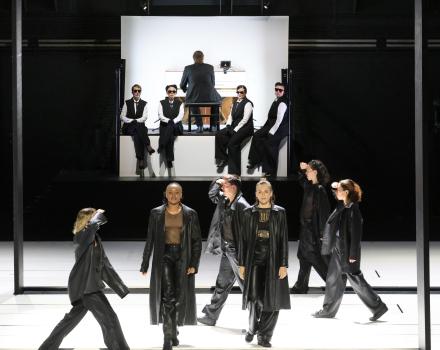
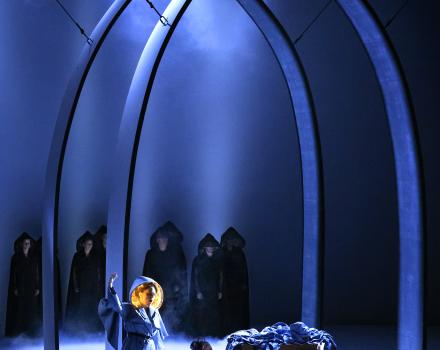
Commissioned by the Holland Festival and De Nederlandse Opera, De Materie was completed in 1988 and first staged by Robert Wilson a year later. Andriessen wrote it on his own terms: no opera chorus, no standard orchestra, but a tenor, a soprano, two speakers, eight voices and a large ensemble thick with percussion and saxophones. Here Bach and Stravinsky meet Steve Reich, boogie-woogie and disco. Avant-garde at the time, with music that swings. For conductor Bas Wiegers, Hadewijch’s visions are the most beautiful notes Andriessen ever wrote. Opera Ballet Vlaanderen’s production is conducted by Bas Wiegers with the company orchestra and the Brussels contemporary music ensemble, Ictus. Phia Ménard directs and designs a scenography that moves with the piece, and KOR’SIA created the choreography of the Mondrian movement.
CAST
|
Gorlæus
|
Robin Tritschler
|
|---|---|
|
Hadewijch
|
Katrien Baerts
|
|
Dancers (speaking role)
|
Samantha Hines
Ausia Jones
|
|
Marie Curie
|
Lies Pauwels
|
|
Dancers
|
Dansers Opera Ballet Vlaanderen
|
|
Chorus & Orchestra
|
Symfonisch Orkest Opera Ballet Vlaanderen
Ictus Ensemble
|
|
Music
|
Louis Andriessen
|
|---|---|
|
Conductor
|
Bas Wiegers
|
|
Concept
|
Phia Ménard
Jan Martens
|
|
Staging
|
Phia Ménard
|
|
Choreography
|
Antonio de Rosa
Mattia Russo
Phia Ménard
|
|
Costumes
|
Marie La Rocca
|
|
Lights
|
Éric Soyer
|
|
Chorus master
|
Jan Schweiger
|
|
Dramaturgy
|
Tom Swaak
|
|
Assistant choreographer
|
Zoe Ashe-Browne
|
|
Sound design
|
Maarten Buyl
|
STORY
De Materie explores, in four self-contained parts – each with its own musical and textual sources, and its own time periods, themes and main characters – a philosophical question: how the human mind interacts with matter? Can we remodel the same material over and over again? With wood we can create a ship, the roof trusses of a cathedral or a bass clarinet. Conversely, material circumstances determine the extent to which a society is hindered or energised in its growth.
Part I: The matter
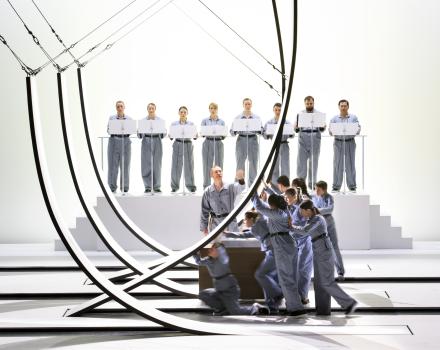
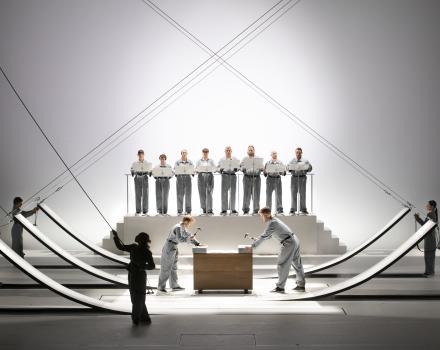
The year is 1581. A loud boom rings out from the orchestra. Silence. Another boom. Faster and faster, 144 musical hammer blows follow one another. In the same vein, the United Provinces of the Low Countries – sung by eight choristers – bellow King Philip II out of the door. With metronomic precision, they overcome their internal diversity (expressed in rich harmonies) and, with their Plakkaat van Verlatinghe (‘Declaration of Independence’), break away from Spanish rule. After the oppression there is now space for progress; destructive banging turns into the optimistic hammering of a shipyard. Amidst the numerous ship’s parts, tools and craftsmen stands Gorlæus, a young, 17th-century philosopher with radical ideas. All matter, he believes, is composed of the tiniest particles – atoms – which cannot be further divided.
Part II: Hadewijch
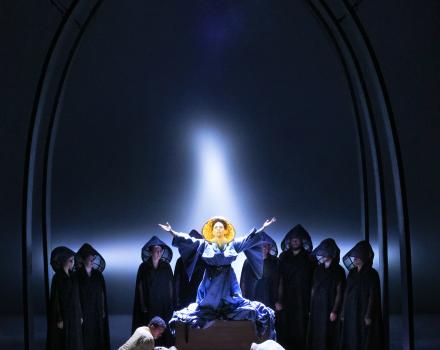
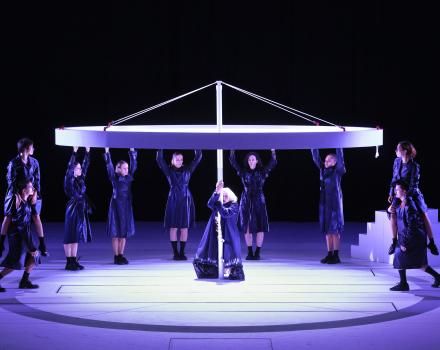
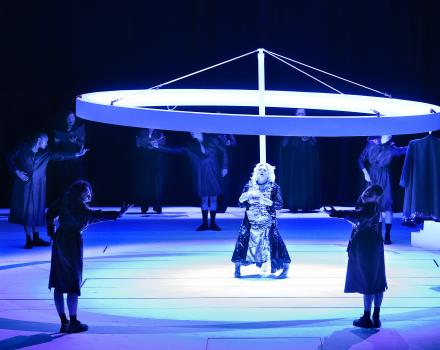
Midway through the 13th-century. Knowledge of God is reserved to the erudite;, their insights mediated by endless reading and commentary in academic terminology. Through tireless love, Hadewijch discovers that she can enter into direct contact with God. Occasionally, her endless yearning is briefly rewarded. Today – Pentecost Sunday – she has such a vision. Early in the morning, she is in church with her community, and then it happens. Overcome by longing, she sees God on the altar. He comes towards her and presses her close to Him; she senses Him in every limb and shivers with passion.
Part III: The style
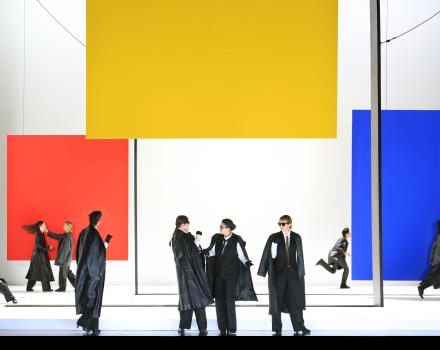
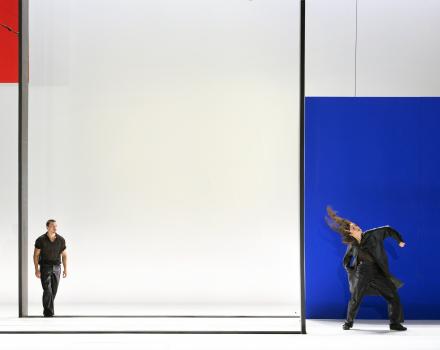
This lively section is devoted to Piet Mondrian, although he does not appear in person. At the outbreak of World War I, he found himself in the Dutch artists’ village of Laren. There he met the colourful thinker Mathieu Schoenmaekers, who was working on an abstract and all-encompassing theory. Schoenmaekers’ geometry – from which the chorus sings a passage – is said to have exerted a decisive influence on Mondrian. In Laren, Mondrian also met Maaike Middelkoop. Decades later, she recalled her memories of him. Mondrian – the painter of strict straight lines – was, it turns out, mad about dancing.
Part IV: Madame Curie
Slowly and enigmatically, the final part gains momentum. Chords resonate and radiate, forming a spellbinding and stately pavane. Tension builds steadily, culminating in a choral passage set to sonnets by Willem Kloos. His lyrical verses on the great themes – love, life and death – introduce the final protagonist. Marie Curie, who fathomed the deepest mysteries of matter, describes her scientific work and her harrowing grief on the death of her ‘petit Pierre’.
GALLERY