Ifigenia in Aulide

The Greek army is gathered at Aulis, ready to sail for Troy, but the winds fail. The seer Calchas reveals that the goddess Artemis is angry and demands a sacrifice. King Agamemnon’s daughter, Ifigenia, must die for the fleet to depart. Torn between duty to Greece and love for his daughter, Agamemnon initially uses a ruse to bring Ifigenia to Aulis; he claims she is to marry Achilles. When Ifigenia and her mother Clitennestra arrive and learn the truth, they are devastated. What hero might intervene to save Ifigenia from the altar of sacrifice?
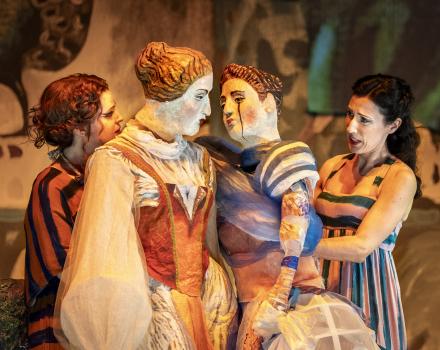
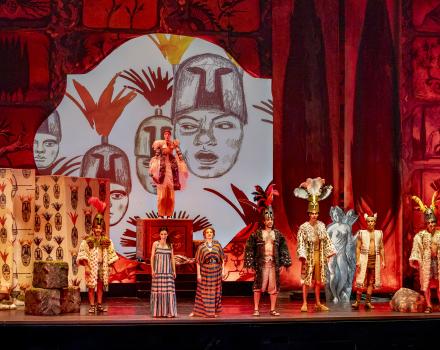
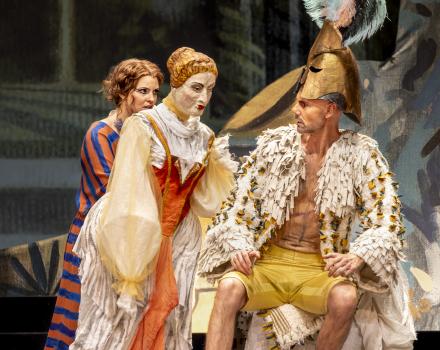
In 1718, the Venetian-born composer Antonio Caldara, while working as Vice-Kapellmeister to the Imperial Court in Vienna, composed his first setting of Ifigenia in Aulide to a libretto written by Apostolo Zeno. Following the fate of the Mycenaean princess Iphigenia, dictated by divine caprice, Caldara's style reveals itself in a magnificent yet psychologically penetrating way. Caldara’s work combines the virtuosity and expressiveness, the structure and counterpoint of the Viennese school influenced by Johann Joseph Fux, and the harmonic fantasy of Dresden court music, with which Caldara maintained close contact throughout his life. Under the Musical Direction of Ottavio Dantone, Innsbrucker Festwochen der Alten Musik’s production is the first staged performance of Ifigenia in Aulide in over 300 years. Appropriately enough for a ‘sacrificial drama’ where the gods pull the strings of human fate, this Ifigenia is staged by the Spanish company PerPoc, which integrates life-size puppets into their productions.
CAST
|
Ifigenia
|
Marie Lys
|
|---|---|
|
Agamennone
|
Martin Vanberg
|
|
Clitennestra
|
Shakèd Bar
|
|
Achille
|
Carlo Vistoli
|
|
Elisena
|
Neima Fischer
|
|
Ulisse
|
Laurence Kilsby
|
|
Teucro
|
Filippo Mineccia
|
|
Arcade
|
Giacomo Nanni
|
|
Dancers
|
Berta Martí
Ivan Terpigorev
|
|
Orchestra
|
Accademia Bizantina
|
|
Music
|
Antonio Caldara
|
|---|---|
|
Text
|
Apostolo Zeno
|
|
Director, costumes and concept
|
Anna Fernández & Santi Arnal (Companyia Per Poc)
|
|
Conductor
|
Ottavio Dantone
|
|
Sets and costumes
|
Alexandra Semenova
|
|
Choreography
|
Cesc Gelabert
|
|
Lights
|
Noxfera
|
Critical edition by Bernardo Ticci and Ottavio Dantone.
VIDEOS


STORY
Backstory
All the Olympian gods were guests at the wedding of the beautiful nymph Thetis (a daughter of the sea god Nereus) to the mortal Peleus. Only Eris, the goddess of strife and contention, was not invited. She took revenge by throwing a golden apple with ‘For the most beautiful’ written on it into the ballroom. Several goddesses claimed the beauty prize: Juno (Greek Hera, the wife of Jupiter/Zeus), Minerva (Greek Athena, the goddess of war) and the goddess of love Venus (Greek Aphrodite). Jupiter finally appointed Paris of Troy as the arbiter, who was considered the most beautiful of all men. He awarded the prize to Venus, who promised him the love of the most beautiful woman in the world as a reward: Helen, whom Jupiter had fathered with Queen Leda. When she reached marriageable age, all the unmarried kings and heroes of Greece courted her; Helen chose Menelaus, king of Sparta. His brother Agamemnon ensured that the rejected suitors promised Menelaus their support should he ever get into trouble. When Paris came to Sparta to claim his reward, however, Menelaus was absent. With the help of Venus, Paris managed to seduce Helen and she followed him to Troy. Thus the alliance fell apart and Helen’s rejected suitors prepared for a campaign of revenge against Troy.
Act I
The Greek ships gather in the port of Aulis (Italian: Aulide) in Boeotia to set sail for Troy in Asia Minor. However, a prolonged calm initially prevents them from continuing their voyage; it is the revenge of Diana, the goddess of the hunt, on Agamemnon (Agamennone), the commander-in-chief of the Greeks, who had killed a hind sacred to her and claimed to be a better hunter than the goddess herself. The seer Calchas (Calcante) explains that Diana can only be appeased by sacrificing Iphigenia (Ifigenia), Agamennone’s eldest daughter. Her father is desperate to save Ifigenia’s life and her fiancé Achilles (Achille, the son of Thetis and Peleus) is also determined to prevent her sacrifice. Agamennone has written to his wife Clytaemnestra (Clitennestra) asking her to come to Aulis with Ifigenia. Odysseus (Ulisse) intercepts a second letter revoking this instruction and so mother and daughter arrive in Aulis. They assume that the wedding of Ifigenia and Achille is to be celebrated there. Agamennone sees no way of saving his daughter’s life: The Greek army is eager to take revenge on the Trojans.
Act II
Achille has conquered the island of Lesbos, an ally of Troy, and brought its princess Elisena to Aulis as a prisoner. Elisena has fallen in love with the conqueror and plots against Ifigenia to prevent his planned marriage to Agamennone’s daughter. Clitennestra and Ifigenia assume that Achille has turned away from his bride and towards Elisena, but he is able to convince them that his feelings for Ifigenia remain unchanged.
Agamennone’s confidant Arcas (Arcade), who knows what fate awaits the princess, reveals this to the two women and to Achille, who intends to prevent Ifigenia’s sacrifice by force if necessary.
Act III
For the vast majority of the Greeks, however, revenge against Paris and Troy is more important than Ifigenia’s life, and so Agamennone has to give in. When Ifigenia realises what is happening, she is willing to die to appease the goddess’ wrath. However, Ifigenia, who is to be sacrificed, is not Agamennone’s daughter. The gods reveal to Calcante that it is in fact Elisena, princess of Lesbos and captive of Achille, who is to be sacrificed. For she is the daughter that Helen had with the notorious womaniser Theseus, before her marriage to Menelaus. The seer learned that the daughter of Helen and Theseus will have to die young, which is why she was raised under a different name. Hence the gods say that Elisena is the real sacrifice demanded by Diana. She then takes her own life. Diana’s anger is thus appeased and Agamennone’s daughter remains alive. The Greeks are able to sail to Troy with a fair wind. Achille, however, will die there and never become Ifigenia’s husband.
Albert Gier
GALLERY