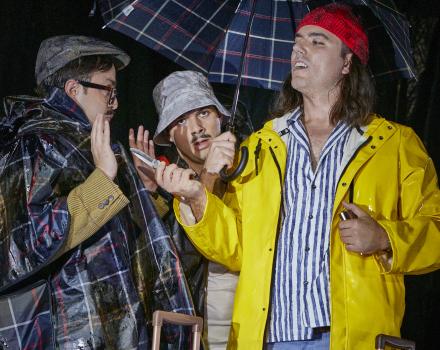
L’occasione fa il ladro

During a storm, Count Alberto loses his suitcase. It is found by Don Parmenione who, discovering a portrait of Alberto’s fiancée Berenice inside, sees an opportunity. He slips into the count’s clothes and sets off to visit Berenice who, at this point, has not yet seen her fiancé. What Parmenione doesn’t know is that Berenice has decided to watch her intended from a safe distance at first, and to this end she and her friend Ernestina have changed places. While Parmenione is wooing the woman he thinks is Berenice, the real Alberto arrives. Initially shocked to find he suddenly has a rival, he is soon charmed by the woman pretending to be his fiancée’s friend. Deception may yet lead the way to true love...
Gioachino Rossini composed the one-act opera L’occasione fa il ladro (Opportunity Makes a Thief) in 1812 - according to some in less than two weeks - and it already contains everything that characterises his later works: barnstorming ensembles, moving and virtuoso arias, comical instrumental effects and the composer’s first storm music. But behind the turbulent plot of L’occasione fa il ladro lie questions of identity theft, social role-playing and the universally human quest to find oneself. In MusikTheater an der Wien’s acclaimed production at the Kammeroper, Marcos Darbyshire directs this comedy of fourfold mistaken identities with a superb young cast.
CAST
|
Berenice
|
Inna Demenkova
|
|---|---|
|
Conte Alberto
|
Alberto Robert
|
|
Don Parmenione
|
Roberto Lorenzi
|
|
Ernestina
|
Petra Radulovic
|
|
Don Eusebio
|
Ilyà Dovnar
|
|
Martino
|
Lazar Parežanin
|
|
Orchestra
|
Wiener KammerOrchester
|
|
Music
|
Gioachino Rossini
|
|---|---|
|
Text
|
Luigi Prividali
|
|
Director
|
Marcos Darbyshire
|
|
Conductor and fortepiano
|
Pedro Beriso
|
|
Sets and costumes
|
Agnes Hasun
|
|
Lights
|
Karl Wiedemann
|
|
Dramatic advisor
|
Kai Weßler
|
A production of ORF III in collaboration with Vereinigte Bühnen Wien and MusikTheater an der Wien at the Kammeroper.
With the permission of Universal Edition, Vienna, acting on behalf of Casa Ricordi S.R.L., Milan.
VIDEOS


STORY
Surprised by a storm, two travellers take refuge at an inn. Count Alberto is going to meet for the first time Berenice, his fiancée. Accidentally Alberto switches their valises, and after he has left, Parmenione opens the count's valise and finds Alberto's passport together with a picture of a beautiful girl whom he assumes to be the fiancée. Parmenione decides to pose as the count and marry her himself. He presents himself at the house of Don Eusebio, uncle and guardian of Berenice. The lady, to discover the character of her betrothed, pretends to be a servant, while her guest, Ernestina, assumes the role of the fiancée. Alberto soon arrives, and each of the men claims to be the count. In the meanwhile, Alberto falls in love with the 'servant' while Parmenione falls in love with the 'mistress' (even though she bears no resemblance to the woman in the portrait). After various humorous and sentimental episodes, everyone's identity is revealed. The count is united with Berenice, while Parmenione gives his hand to Ernestina, the very girl he was sent to trace.
INSIGHTS
Who am I?
Director Marcos Darbyshire on L’occasione fa il ladro
The main theme of Gioachino Rossini’s one-act opera L’occasione fa il ladro, composed in 1812, is identity; the question of who I am and whether others recognise me in this identity. This question is addressed as a concrete situation in the quintet when the real Count Alberto meets the impostor Parmenione and both claim to be Alberto. ‘I am you,’ says one, but the other says, ‘That cannot be, for I am me!’ This situation is the comic climax of the opera, and in the scenes that follow, the characters try to figure out who is actually who. In all five of Rossini’s early farces, there is an ensemble almost exactly in the middle that, in its crescendo and the rapid confusion of all the characters, corresponds to the finale of the first act of a two-act opera buffa. In Il signor Bruschino, it is a trio, and in L’occasione fa il ladro, it is a quintet. The structure of the farces corresponds exactly to that of a two-act opera buffa, except that here everything is more compact and the characters have less time to reveal themselves as multifaceted personalities. The characters here are still types, but that gives us the freedom to play around with them a lot in the production.
Reading the opera’s libretto for the first time, one automatically thinks of Mozart’s Così fan tutte. There are two couples, disguises, and then a man seduces a woman even though he actually belongs to another woman. If you look more closely, another Mozart opera flashes up in the piece, Don Giovanni. At the centre of both operas is a rogue with his servant who flouts social norms and believes he can manipulate or seduce everyone around him. The motif of identity exchange through disguise also appears in Don Giovanni. I do not know if Rossini was aware of this similarity, but in any case, we have included a few references for the audience. As in many comedies, and Le nozze di Figaro would be the best comparison, the women in L’occasione fa il ladro are not only active, they are also funny and carry the humour of the work. The two women here are perhaps a little more well-behaved than Rossini’s later heroines such as Rosina in Il barbiere di Siviglia or Isabella in L’italiana in Algeri. However, as we believe in these role models, we have tried to support the two in our version and our production so that they can stand up to the men. This is particularly successful with Berenice, who clearly states in her aria that she will not marry anyone whose identity is unclear. The wit and intelligence of these two women is what makes this piece so modern. The fact that the male characters seem somewhat more conventional is because they come from different social classes. For example, in the first scene of L’occasione fa il ladro, the servant Martino opens Count Alberto’s suitcase, and only then does Don Parmenione himself seize the opportunity to assume the identity of Alberto. The librettist apparently wanted to avoid putting a bourgeois gentleman on stage as a thief – even though that is precisely what the piece is about. Here, social conventions run counter to the humour of the situation, and we have tried to circumvent these conventions in our version so that the humour of the situation comes across more clearly.
There are three dramaturgical problems in L’occasione fa il ladro that we have tried to solve with a few interventions. In the original libretto, the two ‘right’ couples meet very early on and immediately sing a love duet, which detracts from the tension of the entire work. We therefore deleted the first love duet between Berenice and Alberto, even though it is very beautiful. During rehearsals, it became clear that it is much more exciting when the erotic connection between the two develops gradually and they only come together in their duet in the finale. That is the first problem; the second is that Berenice exposes Parmenione as a fraud relatively early on. We therefore postponed her duet with Parmenione, in which she downright interrogates him, in order not to reveal the key punchline of the plot too early. And the third problem: the role of Ernestina is much smaller than that of Berenice, and we do not really learn anything about her, even though her function in the plot is far more important than that of the servant Martino, who even has his own aria. We invented a backstory for Ernestina by giving her an entrance aria from late Rossini. It is the aria ‘Mi lagnerò tancendo’ with lyrics by Pietro Metastasio. Accompanied by the fortepiano, this aria, with its pathos, contrasts somewhat with the rest of the piece, but this contrast also greatly enriches the character of Ernestina. We are convinced that it is legitimate to make changes to the plot and the dramatic arc if you approach the piece with love and respect. Because with Rossini, every bar is full of humour and wit, and if we want to do justice to his opera, we have to make the audience laugh.
GALLERY